Author: Jo Reimer

  • Do You Really Need to Downsize? Maybe You Just Need to Rethink Your House

    Do You Really Need to Downsize? Maybe You Just Need to Rethink Your House

    Downsizing is one of those words that gets thrown around whenever people start talking about retirement, empty nests, or getting older. The kids have moved out, there are bedrooms nobody uses, and maintaining the house isn’t as much fun as it used to be. If it ever was. I mean, seriously, who REALLY enjoys maintaining a house?

    Naturally, somebody suggests it’s time to downsize. But who says you have to? What if you love your neighborhood, have a mortgage payment you couldn’t come close to replacing today, or you paid off the house, or simply don’t want to pack up decades of belongings? Maybe the question isn’t whether you need a smaller home. Maybe it’s whether you can make the one you already own work better for the life you’re living now.

    My grandmother had the right idea

    My grandmother lived in a small, two-story house in Indiana. As she got older, climbing the stairs to her bedroom became less appealing. Today, someone might suggest that she sell it and buy a single-story house. Grandma had another idea: she turned her dining room into her bedroom!

    She hung curtains between the dining room and living room for privacy, moved the dining area into the front room, which was also next to the kitchen, and continued living in the house she knew. The upstairs bedrooms were still available for occasional use and storage, but she didn’t need to go upstairs to bed every night. It wasn’t a conventional arrangement, but it worked for her. Isn’t that what a home is supposed to do?

    Just because someone labeled a room a dining room doesn’t mean it must remain one forever. An unused bedroom can become a reading room, an office, or a hobby space. You may already spend most of your day in only a few rooms. Before deciding there’s too much house, look at how you actually use it.

    What if you downsized your belongings first?

    I spoke with a prospective buyer who was preparing to move into a smaller home. She started getting rid of things before the move and discovered she really liked having less stuff. So she simplified again, even though she hadn’t changed addresses yet. She was already experiencing part of what she wanted from downsizing without buying a different house. It helped her see what she truly needed, or, didn’t need.

    Think about the spare bedrooms collecting boxes, the dining room that rarely hosts a meal, or the garage that has slowly turned into a storage unit. Clearing out things you no longer use can make your present home feel entirely different. You might discover that the house fits you better than you thought, or you might learn exactly which rooms and storage spaces matter in a future home. Either result is useful.

    Maybe you’re tired of the work, but not the house

    When someone says the yard is too much, my first question is whether they’ve priced a lawn service. Regular mowing, trimming, and seasonal cleanup aren’t free, but neither is selling a home, moving, and buying another one. If hiring someone to take care of the yard solves your biggest complaint, you might spend much less than you would relocating.

    Lawn care service mowing the lawn of a detached house

    The same goes for other chores. Could a cleaning service, gutter maintenance, or occasional help with bigger jobs make life easier? Instead of assuming the house itself is the problem, identify which responsibilities are wearing you out and price the alternatives. You may find you can keep the neighbors, neighborhood, and home you love while outsourcing the jobs you don’t.

    Think about aging in place, not just moving

    Sometimes the house needs to change because your needs have changed. Better lighting, easier-to-use handles, sturdy railings, and a more accessible bathroom can make a meaningful difference. Replacing a traditional tub with a well-designed, low-threshold shower may be worth considering, along with slip-resistant surfaces and reinforcement for future grab bars. Enjoy taking a bath? A walk-in bathtub might be the answer.

    Of course, some modifications won’t be practical. A narrow two-story layout, inaccessible entrances, or a bathroom that can’t be changed without major work could make another home a better answer. The point is to ask what can be improved before assuming you should move.

    Homeowner relaxing at home with her dog

    What my brother-in-law did before retirement

    My brother-in-law took another approach I think is worth considering. While he was still working, he replaced expensive home components that were getting toward the end of their useful lives. He wanted to enter retirement knowing he had already handled some of the big-ticket maintenance he could see coming.

    That’s sensible planning, although a new roof or HVAC system isn’t a guarantee against future repairs. The real lesson is to assess major components while you still have options. How old is the roof? What condition is the heating and cooling system in? Is the water heater likely to need attention? A qualified contractor can help distinguish something that needs work from something that still has years of service ahead. There’s no prize for replacing perfectly good equipment unnecessarily, but planned expenses may be easier to manage than surprises on a fixed income.

    A smaller place can actually cost more

    Here’s where the financial assumption gets interesting. In an October 2026 Facebook discussion, a poster described his parents considering a move from a six-bedroom house to a two-bedroom condo. Once they considered the borrowing costs, property taxes, and condo HOA dues of more than $500 per month, the smaller place would cost more monthly than staying. It’s one family’s reported experience, not a universal rule or independently audited comparison, but the question it raises is excellent.

    How can a house with fewer bedrooms cost more? Your current home might have a paid-off mortgage or a rate you obtained years ago. A replacement property could have a smaller purchase price but higher financing costs, condo dues, taxes, or insurance. And the costs of selling, buying, moving, and setting up the new home matter too.

    On the other hand, lower maintenance demands or better accessibility may be worth paying more for. That’s perfectly reasonable. Just make sure you’re choosing that tradeoff knowingly rather than assuming a smaller house automatically reduces expenses.

    What makes sense in Old Hickory, Madison, Hermitage, and Donelson?

    I work throughout the Nashville real estate market, concentrating on Old Hickory, Madison, Hermitage, and Donelson. These established neighborhoods include homes where people have spent decades raising families and building connections. Those friendships, routines, and familiar places can be difficult to replace, and they deserve a place in the decision alongside the numbers.

    When someone tells me they’re considering downsizing, I’d rather understand what they want to change before we start looking at listings. Is it the stairs, the yard, maintenance, the monthly budget, or simply the amount of stuff? Do they want to live closer to family, travel more, or enjoy a different kind of home? Each answer points toward a different solution.

    Sometimes the right choice is another house. Sometimes it’s a renovation, hiring help, reorganizing rooms, or finally clearing out the things you’ve been meaning to sort for years. And sometimes the smartest real estate decision is not to make a real estate transaction at all.

    Before you downsize, ask one question

    What exactly are you trying to make smaller? Your house, your expenses, your responsibilities, the amount of stuff you own, or the hours you spend taking care of everything? They aren’t interchangeable, and they don’t necessarily call for the same answer.

    If you’re considering a move in the Nashville area, I can help you compare what your current home might sell for with what a different property would realistically cost. But before you start packing, take another look around. You might need a different house. Or, like my grandmother, you might discover a better way to live in the one you’ve already got.


  • Assumable Mortgages in Nashville: What Buyers and Sellers Should Actually Know

    Assumable Mortgages in Nashville: What Buyers and Sellers Should Actually Know

    Assumable Mortgages in Nashville: What Buyers and Sellers Should Actually Know

    For years, assumable mortgages were one of those real estate terms most people had little reason to think about. When mortgage rates were already low, taking over somebody else’s loan was not especially exciting.

    That has changed. Many homeowners who bought or refinanced during the low-rate years still have FHA, VA, or USDA mortgages with interest rates well below what a new buyer may be offered today. Suddenly, the financing attached to a house can be almost as interesting as the house itself!

    But a low rate by itself doesn’t make an assumable mortgage a good deal. The purchase price, remaining loan balance, buyer qualification, equity gap, property condition, taxes, insurance, and the rest of the transaction still have to work together.

    What Is an Assumable Mortgage?

    An assumable mortgage allows a qualified buyer to take over the seller’s existing mortgage rather than replacing it with an entirely new first mortgage. FHA, VA, and USDA loans are assumable, although the rules are not identical across all three programs.

    The buyer still has to qualify, the required approval process still applies, and the seller has to cooperate with the transaction. This isn’t an informal arrangement where somebody simply starts making the seller’s mortgage payments.

    If the assumption is approved, the buyer takes over the existing loan balance, interest rate, and remaining term. The loan balance is the important part, because it is usually not the same as the purchase price.

    The Math Matters More Than the Headline Rate

    Suppose a home is selling for $400,000 and the seller still owes $250,000 on an assumable mortgage.

    The buyer may be able to assume the $250,000 loan if they qualify, but that leaves a $150,000 difference between the remaining mortgage balance and the purchase price.

    That $150,000 is the equity or cash gap, and it still has to come from somewhere. It might come from cash, proceeds from selling another home, or secondary financing.

    If a buyer uses a second mortgage to cover part of that gap, the new loan will usually carry a higher current-market rate. But that doesn’t necessarily wipe out the advantage of the lower-rate assumed first mortgage. What matters is the combined cost of both loans. In the right transaction, the total monthly principal-and-interest payment can still be substantially lower than financing the entire purchase with a brand-new first mortgage at current rates.

    The exact comparison depends on the balances, rates, loan terms, fees, and mortgage insurance if applicable, so this is something to calculate rather than assume.

    For Buyers: Finding the Loan Is Only the Beginning

    Buyers no longer have to hope an assumable loan happens to appear in a normal home search.

    AssumeList.com is one tool built specifically around assumable mortgages. Consumers can subscribe for $29 per month or $69 for three months, while buyers working with a participating agent can get access without paying a separate consumer subscription.

    So you can subscribe and search on your own, or work with an agent who already has access and use it as part of the home search without paying separately just to find the properties.

    I can search for potentially assumable opportunities and then help evaluate whether the financing and the house actually make sense together.

    A search tool may show estimated balances, rates, payments, and cash gaps, but those numbers still need to be verified before they become part of an offer strategy. I want to know what the seller actually owes, what the real payment is, how large the gap is, and what the servicer will require.

    This is also where having an agent who understands assumptions can matter.

    It’s not uncommon for a seller to call the loan servicer and be told, “We don’t do assumptions,” even when the loan program requires the servicer to process a qualifying assumption request. Sometimes the problem is simply getting to the right department or speaking with someone who actually knows the assumption process.

    When a lower-rate loan could save a buyer substantial money over the remaining life of the mortgage, getting the process handled correctly matters.

    A Quick Note on Occupancy

    One important distinction between FHA and VA assumptions is occupancy.

    FHA assumptions generally require the buyer to occupy the property as a primary residence, so they usually aren’t an investor strategy.

    VA assumptions are different. The buyer doesn’t have to be a veteran, and a standard VA assumption doesn’t carry the same owner-occupancy requirement. That means some VA assumable loans can also be worth a look for investors, provided the buyer qualifies and the assumption is approved.

    For a veteran seller, VA entitlement is a separate issue from the buyer’s qualification, so it’s worth understanding before agreeing to an assumption.

    Watch my buyer video:

    https://youtu.be/kx05myi8pi0

    Homeowners With Equity May Have Another Option

    Assumable loans can become especially interesting for someone who already owns a home.

    You may have heard yourself say, “I’d move, but I don’t want to give up my interest rate.”

    Usually, you can’t take your current mortgage with you. But you can take your equity with you.

    Someone selling a longtime home may have enough equity to cover a large portion of the gap on the next property. If that next home also has an attractive assumable mortgage, the combination can sometimes create a financing structure that wouldn’t be obvious if the buyer only compared new mortgage rates.

    That doesn’t mean somebody should move just because an assumption exists. It simply gives homeowners another option to explore when they want something smaller, easier to maintain, closer to family, or simply better suited to the next phase of life.

    For Sellers: Your Mortgage May Be a Marketing Asset

    The seller side of this gets less attention, and I think that is a mistake.

    If your current mortgage is FHA, VA, or USDA, the financing attached to your home may be something we should investigate before the property goes on the market.

    Imagine two similar homes competing for the same buyer. Their prices may be close, their locations may be close, and their condition may be comparable. But one seller has an assumable mortgage with substantially more attractive terms.

    For the right buyer, that can make the second house financially very different.

    That doesn’t mean we slap “2.75% ASSUMABLE!” across an advertisement and call it a day. Before I’d use an assumable mortgage as a listing feature, I’d want the actual loan information verified and I’d want to understand the remaining balance and the buyer’s likely equity gap.

    A seller may have a fantastic mortgage rate but owe relatively little after years of ownership. If the buyer has to bring a very large amount of cash to bridge the difference, the assumption may appeal to a much smaller buyer pool than the interest rate alone suggests.

    On the other hand, a low-rate mortgage with a manageable gap could become a meaningful differentiator when buyers are comparing monthly costs. A meaningfully lower payment may also put the home within reach of buyers who would have passed on the same purchase price with a brand-new mortgage.

    That is why the mortgage should be evaluated as part of the listing strategy, not treated as a gimmick.

    Watch my seller video:

    https://youtu.be/_BH1ztC3olQ

    VA Sellers Need to Ask One More Question

    A buyer doesn’t have to be a veteran to assume a VA loan if the buyer otherwise qualifies. But when a veteran sells a home using a VA assumption to a non-veteran, release from liability and restoration of VA entitlement are two separate things.

    If a non-veteran assumes the loan, some of the seller’s entitlement may remain tied to that mortgage. That doesn’t automatically prevent another VA purchase, but it’s something to understand before agreeing to the assumption, especially if the seller plans to use VA financing again.

    So, Is an Assumable Mortgage Worth Pursuing?

    Sometimes, absolutely. Other times, not at all.

    For a buyer, an assumable mortgage can create a financing opportunity that isn’t available with a traditional new loan. For a homeowner with equity, it may make a move more workable. For an investor, some VA assumptions may open possibilities that FHA assumptions generally don’t. And for a seller, an attractive mortgage can become another feature that helps distinguish the property from its competition.

    But none of those benefits exists in isolation. The house still has to be worth buying. The price still has to make sense. The buyer still has to qualify. The equity gap still has to be covered. And the actual loan terms still have to be verified.

    It isn’t really about finding the lowest rate. It is about finding a house and a financing structure that make sense together.

    Want to Dig Deeper?

    I put together a more detailed Greater Nashville resource covering assumable mortgages for both buyers and sellers:

    https://www.joreimerrealtor.com/assumable-mortgage/

    If you’re considering a move and want me to look specifically for homes with potentially assumable financing, or you’re wondering whether the mortgage already attached to your home could be part of your selling strategy, call or text me at 615-300-2185.

    Mortgage assumptions are subject to existing loan terms, buyer qualification, required approval, seller cooperation, verification of financial information, and transaction-specific requirements. Rates, balances, payments, fees, timelines, secondary financing, property details, and availability may change. Nothing here is a promise of approval, savings, financing, property availability, sale price, or sale outcome.

  • What’s Actually Happening on Nashville’s East Bank?

    What’s Actually Happening on Nashville’s East Bank?

    What’s Actually Happening on Nashville’s East Bank?

    If you live around Nashville, you’ve probably already heard the major East Bank headlines.

    The new Titans stadium is under construction. Oracle is developing its future Nashville headquarters in River North. TPAC is planning a move across the river.

    But those projects are only pieces of a much larger story.

    The broader East Bank covers roughly 550 acres along the Cumberland River, and plans for the area include housing, parks, greenways, roads, retail, offices, entertainment and major infrastructure improvements.

    Some of it is already happening. Other pieces are still being designed, funded or refined.

    And that distinction matters.

    Watch the Full East Bank Video

    Some Parts of the East Bank Are Already Taking Shape

    The new Nissan Stadium is expected to open in 2027, and construction is easy to see from downtown.

    Farther north, the first section of the River North greenway near Oracle’s future campus has already opened. Longer-term plans call for additional walking and biking connections along the river and toward Germantown and Shelby Bottoms.

    Housing is also beginning to take shape.

    The initial Eastpoint plan calls for approximately 1,550 residential units, including both affordable and market-rate housing.

    One of the first major residential projects, Eastpoint Flats, will include 323 income-restricted apartments, ground-floor retail and a childcare facility.

    One detail that stands out is the 99-year ground lease designed to preserve affordability for the project long term.

    So this is not simply a short-term affordable-housing program that is expected to convert to market-rate housing a few years from now.

    What Could This Mean for Nearby Housing?

    So far, much of the confirmed residential development is rental housing rather than for-sale condos or townhomes.

    That distinction could matter to owners and investors in nearby areas such as SoBro and downtown.

    Hundreds of new apartments may create additional competition for renters and affect rents, concessions and investment returns.

    That is different from adding hundreds of new condos that compete directly with existing resale inventory.

    For-sale housing may come later, but that is one of the pieces I am continuing to watch.

    Traffic and Access May Be the Bigger Short-Term Story

    The long-term goal is to make the East Bank easier to navigate by foot, bike and transit rather than relying entirely on cars.

    But getting from today’s East Bank to that finished version is going to involve a lot of construction.

    TDOT has confirmed that the James Robertson Parkway and Victory Memorial Bridge route will close during part of the reconstruction work. Exact closure dates and detours are still being developed.

    That could have a significant effect on traffic between downtown, East Nashville and nearby interstate connections during construction.

    Plans for East Bank Boulevard are also still evolving, including how space will be divided between vehicles, transit, bikes, pedestrians and other uses in different parts of the district.

    Flooding Is Still an Important Part of the Conversation

    Anyone who lived in Nashville during the 2010 flood understands why flood planning matters along the Cumberland River.

    East Bank plans include roads built above the 100-year base flood elevation, stormwater infrastructure, permeable surfaces, bioswales and green space designed to help manage water.

    Some portions of the riverfront are being designed to accommodate flooding rather than pretending flood risk can be eliminated completely.

    For buyers and owners near the East Bank, individual flood-zone status and insurance requirements will still matter.

    The Effects Won’t Stop at the East Bank Boundary

    Even if you never plan to live on the East Bank, the project could still affect how people move around Nashville and how nearby housing markets behave.

    Oracle’s current development projections have included roughly 8,500 permanent jobs by the end of 2031, although that remains a projection and could change as the campus develops.

    Some employees may choose downtown, Germantown or East Nashville, while others may prefer more space and commute from farther out.

    The larger point is that a project of this size can influence traffic patterns, rental competition, housing demand, amenities and how different parts of Nashville connect to downtown.

    There’s Still a Lot We Don’t Know

    The East Bank is no longer just a concept. Major pieces are under construction, housing is moving forward and public infrastructure is beginning to appear.

    But plenty of questions remain.

    Will for-sale housing be added?

    What will parking look like when the stadium, Oracle and TPAC are all operating?

    How will flood mitigation affect insurance over time?

    What everyday businesses will move into the district?

    And how will all of this affect the neighborhoods around it?

    Those are the pieces I’ll keep following.

    If you want the deeper version, including parking, short-term rentals, stadium noise, pedestrian connections and, yes, where all the dogs are supposed to go, watch my full East Bank video on Living Nashville by Jo Reimer, Realtor.

    Because the useful question isn’t just what Nashville is building.

    It’s what changes because it’s being built.

  • Real Estate Wire Fraud Is Getting Harder to Spot, Especially With AI

    Real Estate Wire Fraud Is Getting Harder to Spot, Especially With AI

    Real Estate Wire Fraud Is Getting Harder to Spot, Especially With AI

    If you're buying or selling a house, here's something worth knowing before you get close to closing: real estate wire fraud isn't new, but AI has made it much more convincing. And sometimes the scam doesn't start with fake wiring instructions. It starts much earlier, with someone trying to get access to your computer or accounts.

    The Inquiry That Made Me Stop and Look Closer

    I recently got an inquiry from someone using the name "Marcia Moon." I've seen enough shady messages to be cautious by default, so I Googled the name first. Nothing suspicious came up. No warnings, no other agents flagging her. So I kept going, carefully.

    Marcia wanted to see a property and mentioned setting up a Zoom call with her husband. Before scheduling anything, I asked for ID, proof of funds, and a phone number. She said she'd email the proof of funds, and that her grandson would send her driver's license separately.

    That email arrived with a Dropbox link supposedly containing the license. When I clicked it, a Zoom download tried to start immediately, even though the file was supposed to be an ID, not a meeting link. I closed it right away.

    Then the "proof of funds" email came in, also asking me to download something rather than just view an attachment. That was enough. I told Marcia I wouldn't be downloading anything and asked her to put the information directly in the email body. I never heard from her again.

    Other Agents Had the Same Experience

    After I posted about it on social media, other agents reached out. Some were from opposite ends of the country and had received nearly identical inquiries. They'd searched the name too and, like me, found nothing. The pattern only became visible once a few of us compared notes.

    Why Would Someone Want Into an Agent's Inbox?

    Probably not to see the house. Real estate transactions are full of valuable details: names, closing dates, title company contacts, money discussions. Someone with quiet access to that information can watch a deal unfold and strike at the perfect moment: an email that looks like it's from the title company or the agent, sometimes even appearing inside a real email thread, saying wiring instructions have changed.

    For a cash buyer, that can mean the entire purchase price disappears in one transfer.

    AI Has Killed the Old Warning Signs

    The old advice to watch for bad grammar and awkward phrasing doesn't hold up anymore. AI can write polished, natural-sounding emails using real names and real transaction details, if a scammer already has them.

    So the right question isn't "does this email look real?" It's "did I verify this independently?"

    Title Companies Really Do Email Wiring Instructions

    That's what makes this tricky. Receiving instructions by email isn't itself a red flag. What matters is verification.

    Early in your transaction, save your title company's actual phone number and contact person in your phone before you ever need it. Then, when wiring instructions show up, call that number, not one from the email, and confirm before sending anything.

    If you're ever told the instructions "changed," treat that as a reason to stop, not to hurry.

    Watch for Urgency

    Phrases like "send this immediately" or "the account changed" are pressure tactics. Real estate deals do have real deadlines, but none of them are worth skipping a two-minute verification call when the amount on the line is your down payment or your entire purchase price.

    If You Think You Already Sent Money to the Wrong Account

    Act fast. Call your bank immediately, then your title company and agent. You can also report it to the FBI's Internet Crime Complaint Center at IC3.gov. Speed is everything here.

    The Bottom Line

    You don't need to be a cybersecurity expert to buy or sell a home. You just need one habit: never trust wiring instructions because the email looks legitimate. Verify them through a number you already know is real.

    AI can make scams look better. It can't make a phone call any less effective.

    If you're buying or selling around Nashville and have questions about what to expect, I'm happy to help.

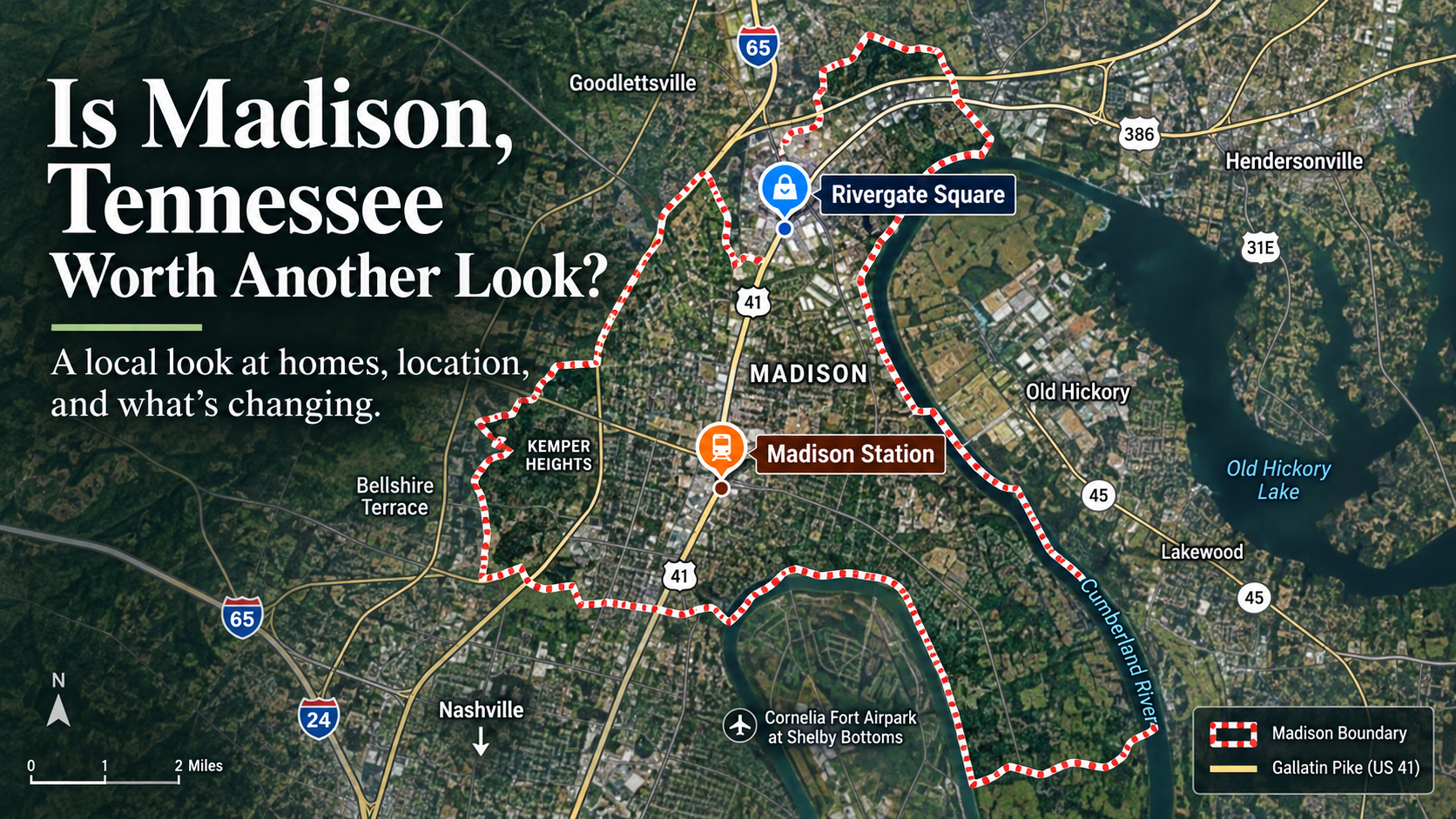
  • Is Madison, Tennessee Worth Another Look?

    Is Madison, Tennessee Worth Another Look?

    Madison has had good years and not-so-good years. So have a lot of places around Nashville.

    What makes Madison interesting right now is that enough is happening at the same time that I think it’s fair to ask whether the cycle may be starting to turn again.

    I’m not telling you Madison is guaranteed to become the next East Nashville. Nobody can tell you that. Nashville has already shown us, though, how quickly people can change their minds about an area once investment, housing demand and redevelopment start stacking on top of each other.

    There was a time when plenty of local buyers wouldn’t have considered East Nashville. Now you hear people say, “I wish I’d bought there back when…”

    The problem is, you only know which neighborhoods those were after the fact.

    Madison may be one of them. Or it may not. But I do think there’s enough happening here that it deserves another look.

    Madison Has Already Been Through This Cycle Before

    This is where the history actually helps explain what you see today.

    Madison grew rapidly after World War II and became a strong suburban community. Madison Square became an important shopping destination, and Gallatin Pike was a big part of how people moved through the area.

    Then RiverGate Mall opened farther north in 1971. Retail followed it. I-65 changed traffic patterns. Businesses moved, and the older Madison commercial core lost some of the activity that had made it successful in the first place.

    Eventually RiverGate aged too. The enclosed mall closed in February 2026, and the 57-acre property is now moving into a major mixed-use redevelopment.

    So Madison didn’t just wake up one morning and become what you see today. The center of gravity moved. More than once.

    That matters because now the two places that helped define different eras of Madison are both changing, and they sit near opposite ends of the same Gallatin Pike corridor.

    That’s where this gets interesting.

    Two Big Redevelopments. One Long Corridor.

    Madison Square is still an active shopping center, but the larger Madison Station plan is intended to redevelop the site over time into a mixed-use district with housing, retail, office space and public improvements. Metro has already completed Madison Station Boulevard, and additional planning around the site includes future park space and transit-oriented improvements.

    Farther north, the former RiverGate Mall property is planned as a large mixed-use redevelopment. Current plans call for new housing, retail and dining, entertainment, office and medical uses, public green space and new streets and infrastructure.

    So now you’ve got one major redevelopment around Madison Square and another near RiverGate.

    Which raises the question I think is more interesting than either project by itself:

    What happens in the middle?

    Parts of the Middle Are Already Changing

    The old Kmart at the south end of Gallatin Pike didn’t just sit empty. Eastside Bowl moved into part of it, and other space in the property has been reused as well.

    That’s not a rendering. That’s already there.

    The site is also close to where Gallatin Pike meets Briley Parkway, which makes it an important gateway into this side of Madison.

    Then you turn off some of the commercial stretches and find established residential neighborhoods that can look very different from the road out front.

    That’s one of Madison’s quirks. The commercial corridor doesn’t always tell you much about the housing behind it.

    And that’s part of why Madison can surprise you.

    The Housing Isn’t One Thing Either

    Madison has a broad mix of housing. Depending on where you’re looking, you can find ranches, split-levels, older brick homes, cottages, renovated houses, townhomes, apartments and newer construction. Lot sizes and layouts can change quite a bit from one part of the area to another.

    That means you really can’t boil Madison down to one house type or one price point.

    And if you’re buying, you’ve got to compare more than just the house in front of you.

    I had a Madison listing that made that very clear. The house had been renovated so extensively that when you walked inside, it felt almost like new construction. But it was still originally built in 1930.

    A buyer’s agent showed it, and his client was also looking at nearby new construction. The new house offered more square footage for about the same money.

    There it is.

    The new construction wasn’t a comp to the 1930 house, but it absolutely was competition for the buyer’s dollars.

    That’s a distinction sellers need to understand.

    A seller can look at the renovation and think, “But we replaced everything!”

    The buyer may be looking at it and thinking, “For about the same payment, I can get more square footage and a brand-new house.”

    Neither side is necessarily wrong. They’re just looking at the same decision from opposite sides of the table.

    Why “What Did the House Down the Street Sell For?” Isn’t Enough

    Comps matter, but buyers aren’t shopping with an appraisal grid in their hand. They’re comparing choices.

    A renovated older home may be competing with new construction. A ranch may be competing with a townhome. A larger older house may be competing with something smaller that needs less maintenance.

    So before you decide a Madison house is a bargain because it’s cheaper than what you were seeing somewhere else, ask yourself what else you can buy for the same money. Then come back to the house and see if you still like it best.

    That’s a much better test.

    Older Homes Still Have Things Buyers Want

    Madison has plenty of older housing that gives buyers things they still ask me for: one-level living, brick construction, mature trees, bigger yards and, in many cases, no HOA.

    But age is age. Sometimes that means normal maintenance. Sometimes it means older systems, questionable repairs, additions, drainage problems, electrical or plumbing updates, windows, HVAC or roofing.

    And sometimes you walk into a beautifully renovated home and the real question is what happened behind the walls.

    New construction has problems too. They’re just different problems.

    Gallatin Pike Still Matters

    Gallatin Pike isn’t just Madison’s commercial corridor. It’s also a direct route toward downtown Nashville.

    That mattered when Madison was growing, and it still matters now. It gives the area access into the city, but it also carries traffic, commercial uses and much of the redevelopment pressure we’re talking about.

    There’s also a larger transportation story happening along the corridor. Nashville’s Gallatin Pike All-Access Corridor planning includes higher-frequency transit, safety improvements and accessibility work stretching from downtown toward RiverGate.

    If Madison Station becomes a stronger destination and the RiverGate redevelopment does too, there may be more reasons for people to travel that corridor.

    That could be good for businesses and could change how people use the area. It may also mean more traffic and construction along the way.

    Those things can all be true at the same time.

    And Then There’s the Old Hospital

    The former Memorial Hospital campus on Due West is another property I’d watch.

    It’s a large underused site not far from Madison Station. I don’t know what ultimately happens there, and I’m not going to make something up just because it makes a better story.

    That’s exactly the point. When a property that large sits near major redevelopment, it’s worth paying attention to what actually gets proposed and approved rather than pretending we already know the answer.

    Madison Has a History People Forget

    There’s another side of Madison that doesn’t get talked about nearly as much.

    Amqui Station is a good example. Johnny Cash acquired the historic station in 1979, saving it from demolition. It was later returned to Madison, restored, and today it serves as a museum, visitors center and community gathering place.

    That doesn’t sell a house by itself. It does remind you that Madison has its own history and identity beyond whatever impression you get from a quick drive along Gallatin Pike.

    What Could Go Wrong?

    A lot, which is exactly why I’m not calling this a sure thing.

    Redevelopment can take longer than expected. Projects can change. Traffic can get worse before infrastructure catches up. New investment can improve one part of an area without doing much for another.

    And not every residential pocket is going to be affected equally just because something new gets built a few miles away.

    That’s the part real-estate marketing tends to skip.

    I’m not going to.

    If You’re Buying in Madison

    I wouldn’t buy here because you’re betting that prices are going to take off.

    That’s backwards.

    Buy because the house works for you now, the payment works, the layout works and the location makes sense for where you actually go.

    Then, if the area keeps improving around you, great. Treat that as upside, not the reason you bought.

    And don’t assume the commercial frontage tells you everything about the residential pocket behind it.

    Drive in. Look around. Compare.

    Some of Madison may surprise you.

    If You Own a Home in Madison

    The same changes matter on the selling side, but in a different way.

    You still have to sell into the market that exists today. Your buyer may be comparing your house with a renovated resale, a brand-new house, a townhome or another neighborhood altogether.

    So if you bought during the frenzy a few years ago, what you paid then doesn’t automatically tell you what the market will support now.

    Financing changed. Buyer choices changed. Inventory changed. Madison itself is changing.

    The useful question isn’t, “What did I pay?”

    It’s: “What is my home competing against now?”

    So, Is Madison Worth Another Look?

    I think it is.

    Not because every house in Madison is suddenly a great investment, and not because I’m declaring it the next East Nashville.

    It’s worth another look because Madison has already been through more than one cycle. Now you’ve got major redevelopment planned around Madison Square, a major redevelopment underway at RiverGate, adaptive reuse already happening along Gallatin Pike, transportation improvements in the works, and established residential neighborhoods sitting behind commercial stretches that don’t always tell the whole story.

    The funny thing about neighborhoods is that everybody wants to know which one is next, but by the time everybody agrees, the cheap part is usually over.

    I’m not telling you Madison is guaranteed to be one of those places.

    I’m saying there’s finally enough happening here that I wouldn’t dismiss it based on what you remember it being.

    If you’re considering buying or selling in Madison, look at what’s there now, then look at what’s actually changing.

    That’s a much better way to make the decision than relying on Madison’s old reputation.

    Want a broader look at housing, local places, access and what buyers and sellers should know about the area? Explore the Madison Neighborhood Guide, or contact Jo to talk through a specific property or move.

  • How Much Money Do You Need to Buy a House in Nashville? 5 Home Buying Myths That May Be Holding You Back

    How Much Money Do You Need to Buy a House in Nashville? 5 Home Buying Myths That May Be Holding You Back

    A lot of people never actually ask me, “How much money do I need to buy a house?”

    They’ve already answered the question themselves.

    Usually with something along the lines of:

    “I probably don’t have enough.”

    Maybe they’ve heard they need 20% down. Maybe they think their credit has to be perfect. Maybe they still have a car payment, credit cards or student loans and assume they need to get rid of all of that before they can even think about buying.

    Then there are closing costs.

    They may not know exactly what those are either, but they know they cost money, so apparently we need another pile of cash for those too.

    Before long, somebody who may actually have options has completely disqualified themselves without ever talking to a lender.

    That’s the part I want to fix.

    Not everyone is ready to buy a home today. But you might be closer than you think, and finding out is a whole lot better than assuming.

    Myth #1: Do You Need 20% Down to Buy a House?

    No. You do not automatically need 20% down.

    There are loan programs that allow qualified buyers to purchase with considerably less than that, and there are also down payment assistance programs available for some buyers.

    Does that mean putting less down is always the best choice?

    Nope.

    How much you put down can affect your monthly payment, mortgage insurance, cash reserves and other parts of the loan. That is why I would rather have you compare your actual options with a good lender than pick an arbitrary percentage because somebody told you 20% was “the rule.”

    It isn’t.

    And please don’t empty your entire savings account just because you technically can.

    Owning a home is a whole lot more comfortable when you still have money left after closing. Houses have a funny way of eventually needing something.

    Usually when you have just spent money on something else. 😂

    Myth #2: Does Your Credit Have to Be Perfect to Buy a House?

    No.

    Your credit matters, but perfect credit is not a requirement for every mortgage program.

    Different loan programs and lenders have different qualification standards, and your credit is only one part of the financial picture.

    I’ve seen people assume they need to spend another year or two trying to reach some magical credit score before they even talk to a lender.

    Sometimes improving your credit first absolutely makes sense.

    But wouldn’t you rather know?

    And here’s something else I want buyers to understand: a good lender is not going to be horrified if you’re not mortgage-ready yet.

    That happens all the time.

    A great lender will look at where you are now, explain what is helping or hurting you, and help you create a realistic path toward buying when it works for you.

    Maybe that means improving your credit. Maybe it means paying down a particular debt. Maybe you need more time to save. Maybe there is something on your credit report that needs attention.

    Whatever it is, you should leave that conversation knowing what the next steps are.

    If a lender simply tells you, “Work on your credit,” and sends you on your way without explaining what that means or giving you useful direction, I’d find another lender.

    A great lender should have your best interests at heart. They should want to help you make a smart decision now and hopefully still be your lender years from now when you buy again, refinance, or send somebody you care about their way.

    I know several lenders I trust who approach buyers that way.

    So if you find out you’re not ready today, that is not a failure.

    It just means now you have information and a plan instead of an assumption.

    Myth #3: Do You Need to Be Debt-Free Before Buying a Home?

    Again, no.

    Having debt does not automatically mean you cannot buy a home.

    Lenders look at your overall financial situation, including your income and monthly debt obligations. That can include car payments, credit cards, personal loans and other recurring debts.

    Being debt-free might be lovely.

    So would winning Powerball.

    Neither one is a prerequisite for talking to a lender. 😂

    The important question is whether the numbers work for your situation and whether the resulting house payment fits comfortably into your life.

    Myth #4: Can You Buy a House With Student Loans?

    Student loans do not automatically prevent you from buying a home either.

    They can affect how a lender calculates your monthly obligations and how much you may qualify to borrow, but having student loan debt does not mean homeownership is automatically off the table.

    This is another one where people sometimes disqualify themselves before anyone has actually run the numbers.

    Don’t do that.

    Let the lender tell you how the student loans affect the calculation.

    Then you can make a decision based on facts instead of mythology from the internet.

    Or whatever AI happened to tell you that day. 😂

    Myth #5: You Need a Huge Pile of Cash to Buy a House

    This one deserves a little more explanation because there are expenses involved in buying a house.

    But how much cash you need can vary tremendously from one transaction to another.

    I had one buyer whose transaction is a great example.

    She qualified for a THDA down payment assistance program, and we were also able to negotiate for the seller to pay allowable closing costs and prepaids.

    When we got to closing, she did not have to bring cash to close.

    Now, before anybody gets too excited, that is absolutely not what happens on every transaction.

    Her loan program, her qualifications, the property, the contract we negotiated and the seller’s willingness to contribute all had to work together.

    But I love her story because it shows exactly why I don’t want buyers assuming they cannot buy simply because they don’t have a giant pile of cash sitting in the bank.

    Sometimes there are options you don’t know exist until you ask.

    So What Money Might You Actually Need to Buy a House?

    Even if your down payment is less than you expected, there are several other expenses buyers should understand.

    Down Payment

    Your down payment depends on your loan program and the financial strategy you choose with your lender.

    The important thing is that 20% is not automatically the starting point.

    Earnest Money

    Once you go under contract, your purchase agreement will usually require you to make an earnest money deposit, often called EMD, within a certain number of days.

    Think of earnest money as a good-faith deposit showing that you are serious about buying the property.

    The amount can vary depending on the home, price point and terms of the offer.

    If the transaction closes, that money is credited toward the funds you owe as part of the purchase.

    So it isn’t another mystery expense floating off into the universe.

    Home Inspection

    Most buyers choose to have the home professionally inspected.

    The inspection gives you a much better idea of the condition of the property and may uncover things that weren’t obvious while you were wandering through the house deciding where your sofa would go.

    The inspection is generally paid by the buyer at the time it is performed, so this is usually money you need before closing.

    And yes, sometimes the report comes back 47+ pages long and looks terrifying.

    That does not necessarily mean the house is falling down.

    A good inspector is supposed to point things out. My job is to help you sort through what is routine, what deserves attention and what may actually affect your decision about the house.

    Appraisal

    If you are financing the purchase, your lender will usually require an appraisal.

    The appraisal helps the lender determine whether the property’s value supports the loan.

    Depending on your lender and loan, the appraisal may be another expense you pay before closing or as part of the loan process.

    Nobody gets particularly excited about paying for an appraisal, but there it is.

    Closing Costs

    Closing costs are separate from your down payment.

    They may include lender fees, title-related costs, recording fees and other expenses associated with completing the transaction.

    The amount varies depending on the loan, property and transaction.

    This is why I would much rather have buyers get real numbers from a lender early instead of relying entirely on an online calculator.

    Online calculators can be useful.

    They can also have you convinced you’re either buying a mansion or living in your car.

    Real numbers are better.

    Prepaid Taxes and Insurance

    You may also have prepaid expenses such as homeowners insurance and property taxes.

    Depending on your loan, part of your monthly payment may eventually go into an escrow account so those expenses can be paid when they’re due.

    Your lender may collect money at closing to establish that account.

    That can make the final cash-to-close number look larger than buyers expected if nobody explained it beforehand.

    Surprises are great for birthday parties.

    They are less fun at closing.

    Can a Seller Pay Some of Your Closing Costs?

    Sometimes.

    Depending on the loan program, the contract terms and current market conditions, a seller may agree to contribute toward allowable buyer closing costs and prepaids.

    That can be helpful if a buyer has enough money for the down payment but would prefer to keep more cash in reserve.

    But seller concessions are negotiated.

    They are not guaranteed, and they don’t make sense in every transaction.

    This is one more reason I don’t believe every offer should look exactly the same.

    The offer should make sense for the house, the market and the buyer sitting in front of me.

    Real estate is not one-size-fits-all, no matter how much the internet would like it to be.

    What Do You Usually Pay Before Closing?

    Some costs may come out of pocket while you’re under contract rather than at the closing table.

    Those can include:

    • Earnest money

    • Home inspection

    • Appraisal

    • Certain lender-related expenses

    Then the remaining funds required for the purchase are typically handled at closing.

    So no, you do not usually walk into the title company with one giant suitcase full of money and dramatically slide it across the table. Besides, the funds need to be wired anyway.

    The Better Question Isn’t “Can I Afford to Buy?”

    At least not until you have real numbers.

    The better questions are:

    What would buying look like for me?

    How much cash would I actually need?

    What would my monthly payment look like?

    What loan programs might fit my situation?

    How much money would I still have left after closing?

    That last question matters.

    I would much rather see somebody buy a home comfortably than spend every last dollar getting the keys and then have the water heater decide two weeks later that it has lived a full and meaningful life.

    You want enough left over that a broken dishwasher is annoying, not a financial emergency.

    Don’t Disqualify Yourself Before You Even Start

    You may talk to a lender and discover you’re not ready yet.

    That’s okay.

    A good lender should help you understand exactly what needs to happen next so you have a path forward instead of a vague instruction to “work on things.”

    Or you may discover that some of the things you’ve been worrying about aren’t keeping you from buying at all.

    Either way, facts are much more useful than assumptions.

    If you’re thinking about buying, I’ve put together a Nashville Home Buyer First Steps Guide to help you understand what happens before you ever write an offer.

    [Get the Nashville Home Buyer First Steps Guide]

    And if you’re still wondering, “Could I actually buy a house?”

    That’s a perfectly good place to start.